Representative End User Clients







Representative Automation Clients







Representative Software Clients








Industrial enterprises cannot safely scale agentic AI simply by bolting sidecar copilots onto fragmented OT data environments. ARC recommends starting with a governed Industrial Data Fabric that validates first-mile data quality at the machine edge, actively purges corrupted agent memory scratchpads, and strictly isolates deterministic control from probabilistic reasoning.
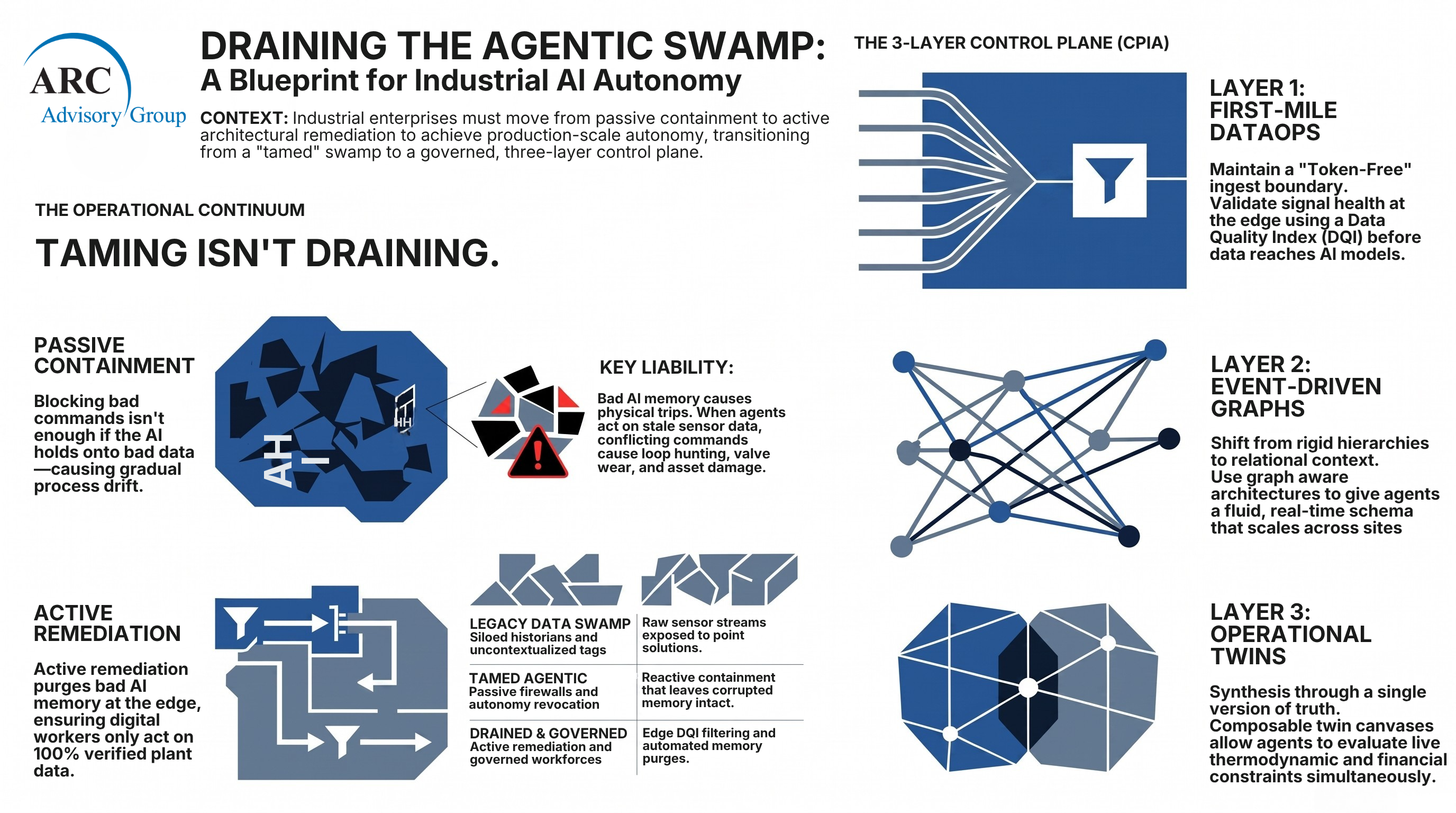
If you’ve been following our ongoing research voyage here at ARC Advisory Group—or if you’ve ever sat through one of my conference sessions where I attempt to explain complex software architectures over a strong cup of tea—you know that, in my July 1, 2026, piece, “Taming the Agentic Swamp: Anchoring Autonomy with Industrial-Grade Data Fabric,” we confronted a rather alarming operational failure mode: the rise of the Agentic Swamp.
We examined how autonomous digital workers, if let loose without strict data quality firewalls, tend to spin up unauditable scratchpads, temporary databases, and uncoordinated memory layers. On an uncarpeted plant floor, that isn’t just bad housekeeping; it can trigger severe control-loop oscillations, physical asset damage, and direct threats to site safety.
Shortly after that piece went live, my good friend, seasoned industrial software veteran, and self-described “Slackerpreneur,” Rick Bullotta, dropped a comment on the LinkedIn publication of “Taming the Agentic Swamp” that gave me a proper chuckle—and a necessary reality check. With characteristic dry wit, Rick wrote:
“Taming the swamp means it’s still a swamp, Colin.”
He is spot on, of course.
| Continuum Stage | Operational Characteristics | Architectural Mechanism |
|---|---|---|
| Legacy Data Swamp | Uncontextualized tags, siloed historians, and shadow IT scripts | Raw, uncurated sensor streams directly exposed to point solutions. |
| Tamed Agentic Swamp | Passive firewalls, quarantine gates, and autonomy revocation | Reactive containment that blocks bad writes but leaves corrupted AI memory intact, leading to process drift. |
| Drained and Governed CPIA | Decoupled Industrial Data Fabric, open standards such as MCP and i3X, and governed Synapse Workforces | Active remediation, edge Data Quality Index filtering, and automated memory purges before AI acts. |
When operations executives implement ingestion firewalls, data quality quarantine gates, and autonomy revocation circuit breakers, we are merely taming the swamp. We are essentially putting a high-visibility fence around a pool of stagnant water and hoping nobody falls in. But as long as that uncontextualized data and uncoordinated memory remain on your shop floor, your digital infrastructure remains a toxic, volatile liability.
In a cyber-physical environment, a “tamed” swamp is an accident waiting to happen. Consider what occurs when an autonomous maintenance agent queries an unsanitized historical vibration tag that suffers from undetected sensor calibration drift. The agent’s reasoning engine, acting in complete good faith, operates on corrupted assumptions.
Even if an active invocation gate pauses write-back execution to physical machinery, the agent’s persistent short-term memory retains that flawed context. The next time the agent runs a multistep planning loop, that stale memory reemerges—causing loop hunting, valve fighting, and subtle process drift that eventually leads to an unplanned plant trip.
Look, none of us have all the answers carved in stone—we are all learning and adapting as wave after wave of AI innovation hits the plant floor. But as we navigate these waters together, one thing is becoming clear: To achieve scalable, trusted autonomy, we have to move past passive containment. We must actively drain the swamp.
When I sit down with plant managers, chief information officers, and vice president-level Operational Technology guardians, a common, slightly weary question consistently surfaces:
“Colin, which single software vendor can we buy to clean up this agentic mess?”
My answer, delivered with as much empathy as I can muster, is always uncompromising: None.
The industrial plant floor is inherently heterogeneous—a complex, multigenerational mosaic built on 20-year-old brownfield machinery, disparate control loops, proprietary fieldbus protocols, and specialized software silos. Slapping a generic, horizontal cloud AI platform onto that environment is a bit like putting go-faster stripes on a lawnmower; it looks flashy in the PowerPoint presentation, but it doesn’t solve the underlying physics.
Waiting for a single automation giant or ERP provider to “drain your swamp” is a strategic dead end that guarantees vendor lock-in, inflated licensing fees, and staggering technical debt.
Before we look at the three layers of our blueprint, a quick health warning for my friends in Operational Technology: Do not confuse these three composable software layers with the legacy levels of the Purdue Model, ISA-95/ISO 15746, or the traditional automation pyramid.
As my colleagues Craig Resnick, Greg Gorbach, and I have argued extensively across our research into the Cyber-Physical Industrial Architecture (CPIA), the legacy Purdue Model was engineered for a completely different era—a 1990s world of rigid, sequential, scan-based data handoffs.
Treating ISA-95 as a physical network execution boundary fundamentally stifles the agility required for modern flexible manufacturing, Software-Defined Automation (SDA), and autonomous agentic mesh networks.
Crucially, CPIA is not just software—it is a holistic architecture encompassing people, processes, and all technology, including hardware and software. While ISA-95 remains a useful semantic vocabulary for manufacturing operations, the rigid physical levels are logically collapsing into unified, edge-native execution environments.
Instead of forcing agents into rigid 1990s levels, pacesetting industrial enterprises are taking strategic ownership of their architecture by intentionally assembling an open, composable, three-layer control plane:
| Control Plane Layer | Primary Architectural Function | Representative Platforms and Ecosystem Partners |
|---|---|---|
| Layer 3: Operational Digital Twins and Composability | Dynamic operational views and multiconstraint evaluation across a single version of truth | AVEVA CONNECT, Cognite Data Fusion®, TwinThread, XMPro, Sight Machine, and Braincube |
| Layer 2: Event-Driven Graph Architectures | Real-time relational context and the mapping of ISA-95 into GraphQL-native event graphs | Rhize Data Manufacturing Hub, Cognite IKG, Siemens Graph Studio, SymphonyAI, and Palantir Foundry |
| Layer 1: First-Mile DataOps and Quality Validation | Edge extraction, protocol translation, and real-time Data Quality Index filtering | HighByte Intelligence Hub, Litmus, Velotic, and Aperio Systems DQI |
Platforms such as HighByte Intelligence Hub, Litmus, and Velotic, which unifies Kepware, ThingWorx, and Proficy, handle the heavy lifting of edge-level data extraction, protocol translation, and payload modeling. But pacesetters pair these DataOps hubs directly with specialized data quality overlays such as Aperio Systems.
Aperio’s self-supervised DataWise™ engines continuously evaluate raw signal health, calculating a real-time Data Quality Index (DQI). DQI is a mathematically rigorous metric that scores incoming sensor streams based on noise variance, flatlining, frozen signals, and calibration drift.
If a transducer experiences subtle drift, the DQI drops below established tolerances—for example, below 95 percent confidence—instantly quarantining the packet before it can poison a downstream reasoning model.
A critical architectural boundary that many IT-led data science teams miss, often after burning through a significant portion of their budgets, is that high-velocity operational telemetry must remain token-free at the edge.
Streaming raw 1,000-Hz vibration tags or unfiltered sensor telemetry directly into an AI language model’s tokenizer is an astronomically expensive computational error. Raw signal validation, protocol translation, and tag filtering must be handled deterministically by edge DataOps and data quality engines. Only cleansed, contextualized events are passed upward to reasoning agents.
To feed autonomous agents the fluid context they require, pacesetters deploy graph-aware context engines. Instead of rigid hierarchical databases, event-driven graph architectures—such as Rhize Data Manufacturing Hub, which maps ISA-95 into a GraphQL-native graph; Cognite’s Industrial Knowledge Graph; Siemens Graph Studio inside Intelligence Center X; SymphonyAI; and Palantir Foundry—treat the operational event as the core driver of change.
This gives agents a fluid, real-time relational schema that scales horizontally across sites without losing operational lineage.
At the enterprise synthesis tier, composable digital twin canvases—such as AVEVA CONNECT, which embeds predictive analytics capabilities; Cognite Data Fusion®; TwinThread; XMPro; Sight Machine; and Braincube—wrap these contextualized event streams into dynamic operational views.
A necessary market note on pending transactions: Schneider Electric and AVEVA have announced definitive agreements to acquire Cognite and TwinThread, respectively, with both transactions subject to customary closing conditions and regulatory approvals. Until those transactions officially close, Cognite and TwinThread operate as independent market entities whose deep domain capabilities are set to become strategically vital to AVEVA’s broader industrial intelligence portfolio.
Nonetheless, Schneider Electric’s strategic alignment of Cognite natively alongside AVEVA and TwinThread does look like a rather brilliant piece of portfolio positioning, doesn’t it?
This composable twin layer ensures that when an autonomous agent queries an asset, it evaluates live operational, thermodynamic, and financial constraints simultaneously across a single version of truth.
To understand how this assembled technical foundation actively drains stagnant digital water, let’s walk through a real-world scenario in a continuous-process chemical facility.
Imagine an autonomous Asset Performance Agent reading live vibration telemetry from a high-pressure feed pump. In an unmanaged “Agentic Swamp,” the agent reads an uncontextualized spike in vibration, opens a temporary scratchpad memory, and autonomously calls an API to trigger an emergency microflow to throttle down the pump.
Simultaneously, a Procurement Agent—unaware of the mechanical vibration—reads a surge in spot-market product pricing and commands a throughput increase across that exact reactor line. The result? Severe control-loop oscillation, rapid valve wear, and an emergency manual shutdown.
Now, let’s look at how an assembled Cyber-Physical Industrial Architecture handles the exact same event using purely functional, decoupled capabilities.
Raw sensor telemetry streams directly into the Edge DataOps Hub at the machine face.
Before the payload reaches the UNS event broker, the Ingestion Firewall evaluates signal health and identifies a subtle 4 percent calibration drift in the vibration transducer.
The calculated Data Quality Index score drops below the 95 percent confidence threshold.
Path A—Signal Failure or Calibration Drift: DQI Below 0.95
Quarantine: The Ingestion Firewall instantly holds the packet back from downstream event brokers.
Memory Purge: The fabric issues an automated memory-purge command to the agent’s containerized sandbox, completely wiping the unvalidated short-term state and draining the potential swamp before bad data causes loop hunting or equipment damage.
Human Mobilization: The fabric routes a diagnostic ticket to a human Context Engineer for physical transducer recalibration and semantic model updates.
Path B—Validated Stream: DQI of 0.95 or Higher
Event Mapping: Cleansed data is released into the Real-Time Event Graph.
Twin Canvas Synthesis: Contextualized events populate the Operational Twin Canvas.
Governed Optimization: The Evaluated Multi-Agent Policy executes closed-loop setpoint adjustments safely within verified physical boundaries.
Rather than handing down rigid decrees from Mount Sinai, let’s frame our next steps as a series of diagnostic questions that cross-functional steering committees encompassing IT, OT, ET, and Data Science should ask during their next executive review.
Why ask this: Deploying autonomous AI agents directly on top of raw, uncurated PLC tags or legacy historian streams forces expensive LLM tokenizers to process noisy, uncontextualized data. This leads to model hallucinations and rapid budget burn.
What good looks like: Establishing a deterministic DataOps and data quality layer at the edge that filters noise, validates signal health, and publishes clean, structured events.
Why ask this: Passive firewalls block unauthorized write-back, but if the agent retains corrupted data in its persistent reasoning scratchpad, that bad context will reemerge in future multistep planning loops, causing subtle operational drift over time.
What good looks like: Implementing automated memory-purge commands that wipe an agent’s containerized scratchpad the instant an edge data quality anomaly or confidence drop is detected.
Why ask this: Streaming high-velocity, 1,000-Hz time-series telemetry directly into cloud AI model tokenizers is an astronomically expensive mistake that exposes the enterprise to public cloud OpEx token volatility.
What good looks like: Calculating signal health and Data Quality Index metrics deterministically on edge hardware using causal AI or rule-based DataOps and passing only contextualized business events upward to reasoning engines.
Why ask this: Monolithic, single-vendor platforms trap your core asset hierarchies, batch recipes, and operational lineage inside proprietary codebases, creating insurmountable switching costs and vendor lock-in.
What good looks like: Taking strategic ownership of a composable, three-layer CPIA that leverages open standards, allowing you to hot-swap edge hardware, cloud backends, or base models without losing your underlying semantic data thread.
ARC Client Action: Use these four diagnostic inquiries to pressure-test your enterprise AI roadmap before advancing from isolated copilot experiments to production-scale agentic deployments.
Now that we understand what architecture must be assembled to drain the swamp, how do we connect these multivendor DataOps hubs, event graphs, and agent runtimes without getting trapped in a new nightmare of custom API glue code?
In our next post, “The Open Architecture Contract: How MCP and i3X Act as the Drainage Pumps of the Autonomous Plant,” we will evaluate how open protocols are providing the universal grammar and vocabulary for the agentic workforce.
The Industrial AI (R)Evolution is moving faster than ever. To dive deeper into the frameworks and data shaping the future of the industrial sector, explore my latest research:
Navigating the AI Wars and the escalating Industrial Robot Wars
Closing the Digital Divide by Embracing Industrial AI
Assembling your Industrial-Grade Data Fabric
Charting the new frontier of Physical Intelligence and transitioning to a Cyber-Physical Industrial Architecture (CPIA)
Mapping your maturity and strategy with ARC's 3-Axis Industrial AI Models Taxonomy
Take our Industrial AI Assessment to benchmark your organization’s maturity, identify critical gaps in your IT/OT/ET convergence, and receive actionable recommendations to accelerate your path toward becoming an Industrial AI Pacesetter.
Don’t guess what your global operations or prospective customers need. Use empirical data to align your stakeholders and de-hype the market with ARC Advisory Group’s Voice of Market Service.