Representative End User Clients







Representative Automation Clients







Representative Software Clients








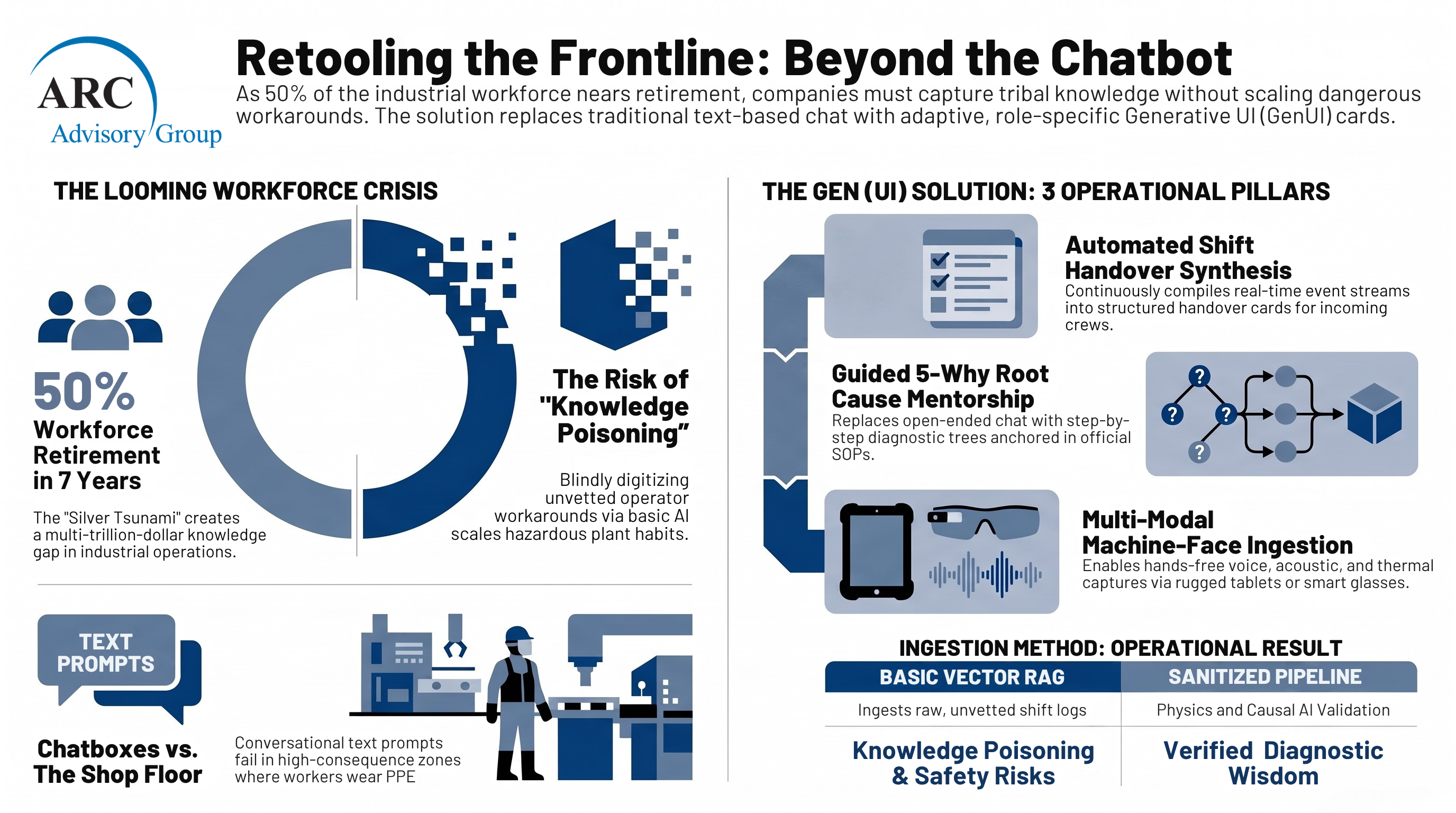
Confronting the industrial "Silver Tsunami" by blindly ingesting uncurated shift notes into vector databases causes Knowledge Poisoning—digitizing and scaling dangerous workarounds. Furthermore, forcing frontline technicians wearing PPE into conversational sidecar textboxes is an ergonomic failure. Pacesetters build an architectural bridge: using Causal AI and physics validation to sanitize tribal heuristics, while deploying Generative UI (GenUI) to deliver hands-free, role-tailored action cards directly at the point of work.
Across the preceding chapters of this blog series, I've systematically explored the technology and topology of the ARC Industrial Copilots MarketMap: machine-face control in Factory Copilots (Blog 3), multi-enterprise logistics in Supply Chain Copilots (Blog 4), and corporate financial steering in Enterprise Copilots (Blog 5).
Blog 6 puts the focus squarely on the human being at the center of the cyber-physical loop: the Connected Frontline Worker. While previous installments examined data fabrics, open grammar (MCP), and inter-agent arbitration, those software architectures ultimately succeed or fail at the point of human contact—whether in the hands of an operator on a continuous chemical line, a maintenance technician in a dark pump vault, or a yard lead on a freezing loading dock.
Let us be candid: confronting the retirement of up to 50% of the experienced industrial workforce over the next seven years is a multi-trillion-dollar macroeconomic transformation that touches vocational education, labor economics, and corporate culture. We are only scratching the surface of that generational future-of-work crisis here. But on the plant floor, in the maintenance bay, and across outdoor logistics yards, operations leaders do not have the luxury of waiting for broad societal shifts. They need to know how software, data fabrics, and interfaces can bridge that skills chasm today without compromising safety, quality, or asset integrity.
As master operators, chemical technicians, and reliability engineers retire, industrial executive committees are caught between two competing schools of thought.
School 1: The Urgent Knowledge Capture Mandate: Advocates argue that industrial enterprises face an unprecedented loss of experiential wisdom. They urge companies to race against time—digitizing every shift note, voice memo, paper log, and operator interview to capture tribal heuristics before veteran workers walk out the door.
School 2: The Future Redesign Paradigm: Skeptics argue that legacy tribal workarounds are far less valuable than assumed. In an operating environment rapidly transformed by software-defined automation, standardized data fabrics, and robotics, legacy habits and unvalidated rules of thumb are often suboptimal—or outright dangerous—and should not be codified into future operating models.
As an analyst, I contend that both perspectives are valid, and enterprise leaders must construct an architectural bridge between them. Industrial companies cannot simply wipe the slate clean; they must continue to run, maintain, and troubleshoot decades-old brownfield physical assets today using experienced heuristics. Simultaneously, they must build a future-ready, digital-first operational model for tomorrow.
This creates profound technology implications for how Industrial Copilots are architected. To bridge brownfield continuity with future redesign, software platforms cannot rely on basic Vector RAG (retrieval-augmented generation) to blindly ingest flat shift notes. Doing so leads directly to Knowledge Poisoning.
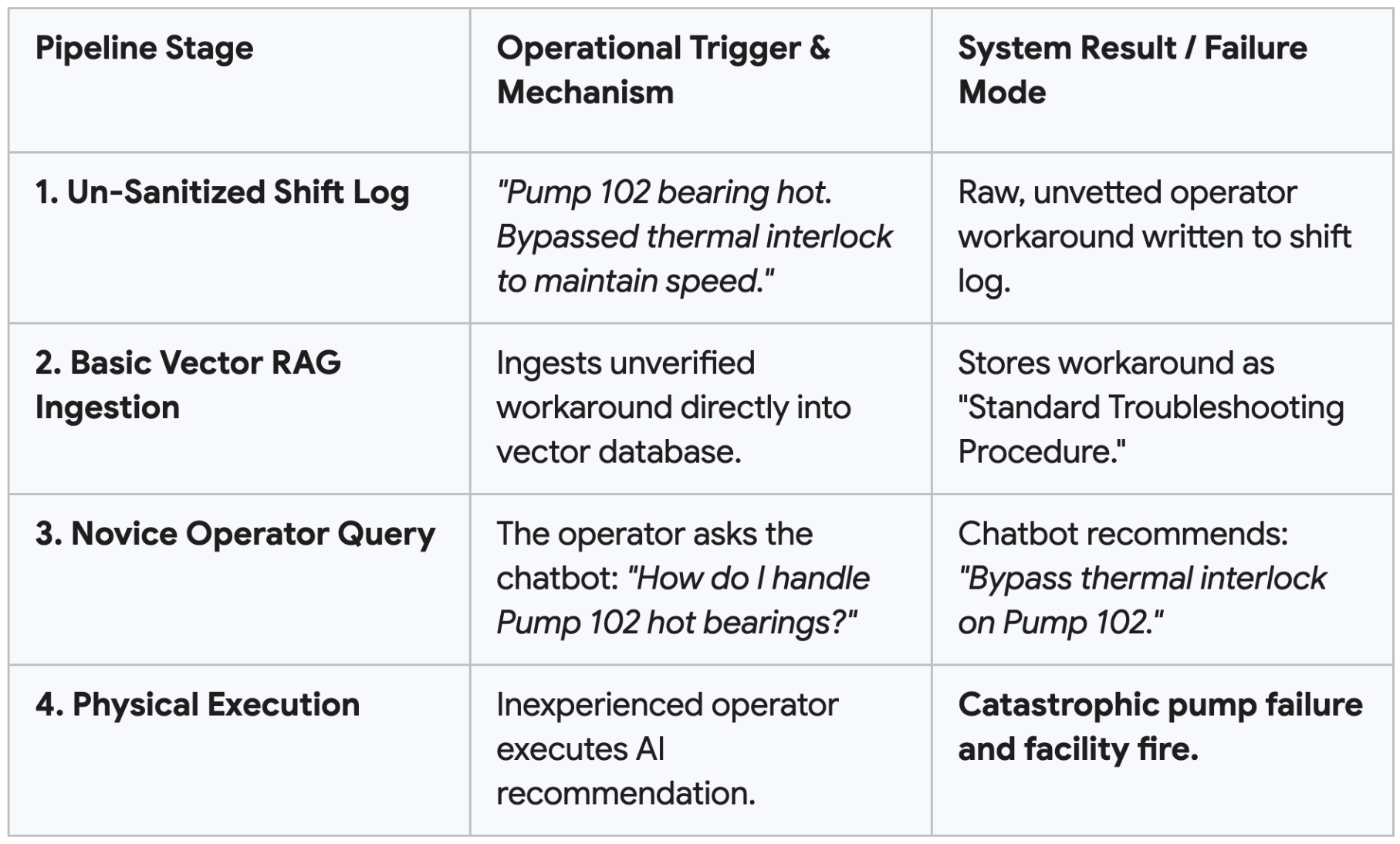
Veteran operators frequently rely on unvalidated workarounds, manual interlock bypasses, and informal rules of thumb that violate official engineering parameters. If an Industrial Copilot blindly ingests uncurated logs via basic RAG, it digitizes, standardizes, and scales bad plant habits across the global enterprise.
Pacesetting Industrial Copilot platforms do not allow raw, unvetted text logs to feed directly into a model's inference loop. Instead, they route tribal data through a technology-driven Sanitization Pipeline that validates legacy heuristics against first-principles physics and causal math before committing them to the Industrial Knowledge Graph:
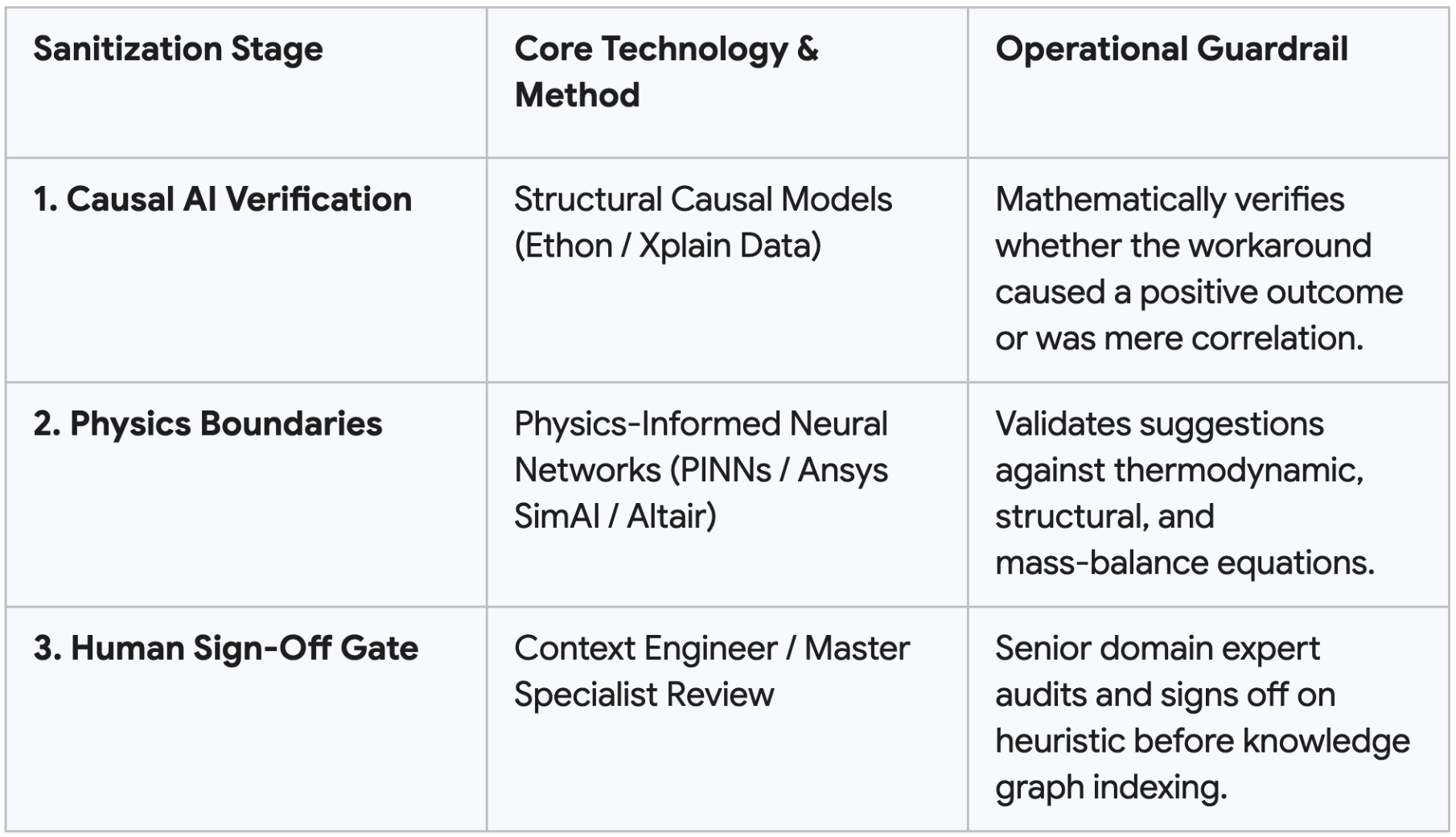
By implementing this technological bridge, enterprise teams solve the Silver Tsunami dilemma: they capture the high-value diagnostic wisdom of retiring veterans, filter out hazardous workarounds via software guardrails, and prepare the digitized knowledge base for organizational transformation—where operators evolve into empowered Synapse Workers™.
Put a standard sidecar chat box in front of a frontline maintenance technician wearing heavy gloves, working in low light, or holding a torque wrench—or a yard manager on an outdoor loading dock—and they will reject it within 48 hours. Frontline worker adoption of traditional sidecar chat windows remains remarkably low—mirroring broader enterprise trends where commercial copilot add-on penetration hovers at much less than 10 percent of total commercial seats.
Conversational text prompts create severe ergonomic friction across physical operational environments. Technicians do not want to become prompt engineers; they need answers delivered within their visual field and physical workflow.
To retool the Connected Frontline Worker, the Industrial Copilot is shifting from additive UI design (cluttered static screens with 5,000 cryptic tags) to Generative UI (GenUI)—auto-generating minimalist, task-specific action cards dynamically at the point of work.
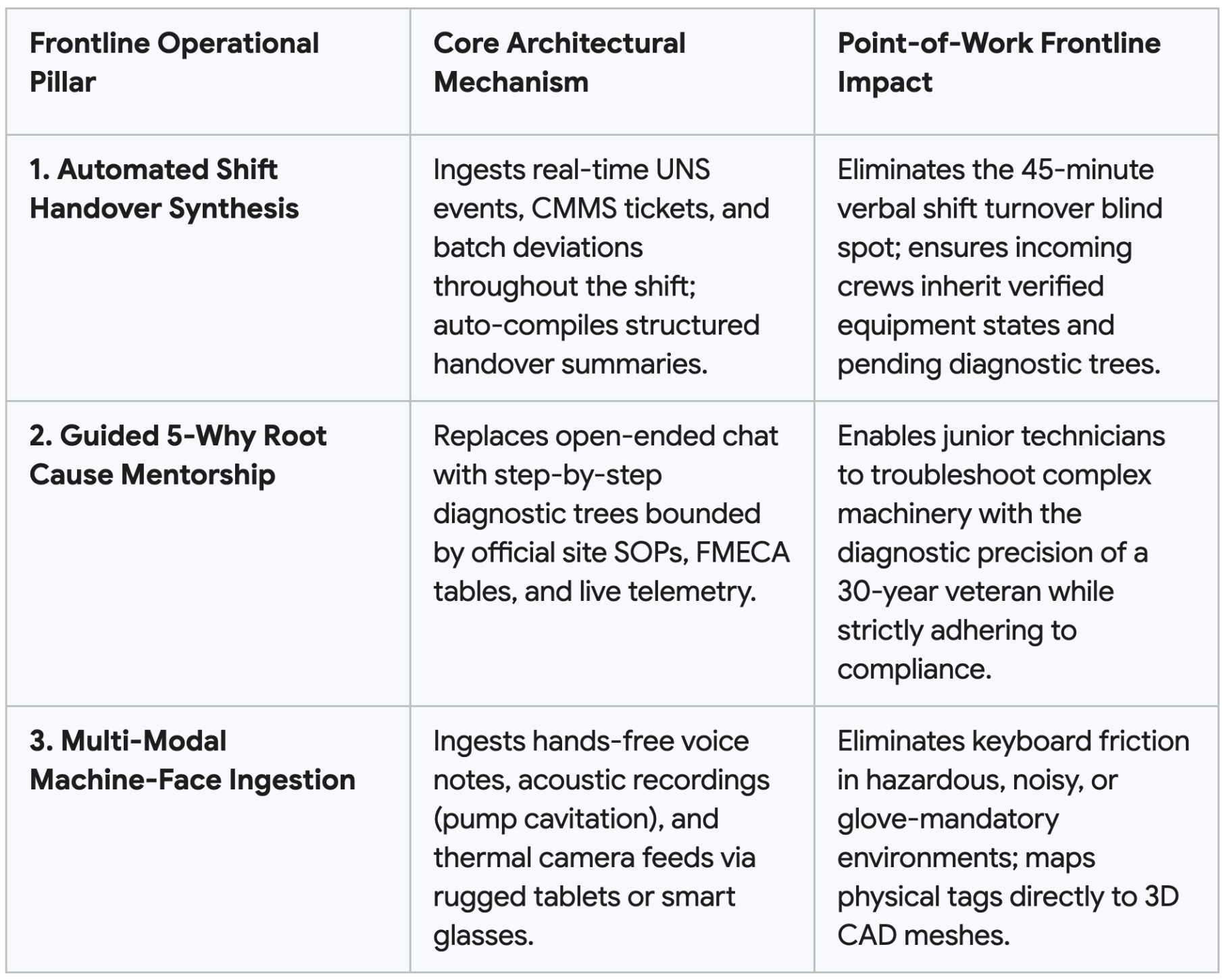
Grounding this shift in Inderpreet Shoker’s foundational ARC research proves that the Connected Frontline Worker (CFW) is not an isolated software tool—it is an Experience Layer. When tethered to an Industrial Data Fabric, GenUI elevates frontline workforce productivity by 2.5x to 4x while eliminating the cognitive burden of manual data entry.
Furthermore, as Matthew Parris (Director, GE Appliances) and Lisa Zasada (General Mills) emphasized at the recent Scaling Smart Manufacturing & Industrial AI Interoperability Forum (co-hosted by CESMII and the Manufacturing Leadership Council), younger operators entering the plant possess a "YouTube Mindset." They do not wait weeks for centralized IT to build dashboards; they expect instant, self-service, visual guidance. GenUI delivers exactly that, unlocking the "Economics of Confidence" across the plant floor.
When evaluating connected worker tools and frontline Industrial Copilot interfaces, use these five essential diagnostic inquiries during vendor RFI reviews:
Knowledge Capture & Sanitization Pipeline: Does your copilot route uncurated shift notes through Causal AI and physics-based validation gates (PINNs, Ansys SimAI) before committing them to the knowledge graph, or does it blindly ingest raw text?
Brownfield Continuity Bridge: How does your platform balance capturing legacy operator wisdom for decades-old brownfield assets with the need to standardize modern, digital-first workflows?
Generative UI (GenUI) Maturity: Does your platform auto-generate task-specific, minimalist GenUI action cards based on live context, or does it force workers to type text prompts into sidecar chat boxes?
Automated Shift Synthesis: Can your solution automatically synthesize shift logs, open maintenance tickets, and live machine events into structured handover cards for incoming crews?
Data Fabric Integration: Is your connected worker tool tethered to an open Industrial Data Fabric (IDF) supplying contextualized machine/SCM data, or does it operate as an isolated software stovepipe?
Equipping frontline workers with Generative UI and physics-sanitized knowledge graphs unlocks massive operational productivity—but how do enterprise CIOs and CFOs finance this computational intelligence without triggering disastrous budget shocks? In Blog 7, we confront the commercial and economic realities of agentic AI: how the collapse of traditional per-seat SaaS (the SaaSpocalypse) and metered cloud API cost spirals (the Tokenpocalypse) demand outcome-based licensing and unmetered CapEx edge supercomputing escapes.
The Industrial AI (R)Evolution is moving faster than ever. To dive deeper into the frameworks and data shaping the future of the industrial sector, explore my latest research:
Navigating the AI Wars and the escalating Industrial Robot Wars
Closing the Digital Divide by Embracing Industrial AI
Assembling your Industrial-Grade Data Fabric
Charting the new frontier of Physical Intelligence and transitioning to a Cyber-Physical Industrial Architecture (CPIA)
Mapping your maturity and strategy with ARC's 3-Axis Industrial AI Models Taxonomy
Surviving the SaaSpocalypse and Taming the Tokenpocalypse by Mastering Multi-Agent Industrial Governance
Organizational Design and the Future of Industrial Work in the era of Agentic AI
Take our Industrial AI Assessment to benchmark your organization's maturity, identify critical gaps in your IT/OT/ET convergence, and get actionable recommendations to accelerate your path to becoming an Industrial AI Pacesetter (and download the 2026 Report). If you think you’re already a Pacesetter, nominate your team for the ARC Industrial Pacesetters Awards!
Don't guess what your global operations or prospective customers need. Use empirical data to align your stakeholders and de-hype the market with ARC Advisory Group's Voice of Market Service.
For tailored recommendations on governing and guiding major people, process, and technology decisions across the enterprise, cloud, industrial edge, and AI, please contact Colin Masson at [email protected].
Or, set up a meeting with my fellow Analysts and I at ARC Advisory Group to find out more about our Executive Insights Service for Industrial organizations and our Industrial AI Insights Service for Vendors.